GEO for Dropshipping: How to Get Traffic from AI Search (Complete Guide)

SIB Content Team
Recently, I came across a Shopify outdoor gear store that sold 30,000 orders in a single month—with almost no ad spend.
No Facebook ads. No TikTok ads. So where did the traffic come from?
AI search recommendations.
If you run a Shopify store or a standalone e-commerce store, you’ve probably spent years focusing on one thing: SEO for Google organic search rankings.
You’ve built backlinks, optimized keywords and meta tags, and continuously refined your pages, all in an effort to climb higher in search rankings and attract more organic traffic.
But the way customers discover products online is changing faster than ever. Instead of typing keywords into Google, more customers are now asking AI assistants questions like:
- Recommend a lightweight hiking backpack.
- Can you recommend an ergonomic nap pillow?
- Mother’s Day is coming. I don’t know what to get for my mom. Any gift ideas?
These questions are being asked directly on platforms like ChatGPT, Google Gemini, and Perplexity. Instead of showing a list of links, these AI systems scan vast amounts of web content, extract key information, and generate instant recommendations. Users get the answer they need without ever clicking on a traditional search result.
Yet these AI-generated answers usually only mention a small number of brands or products. If your store isn’t included in those responses, your brand is invisible to your audience.
This is exactly why GEO (Generative Engine Optimization) was created.
As AI search becomes the new gateway for information, GEO is emerging as the next frontier of organic traffic after traditional SEO. For cross-border e-commerce businesses that depend on search traffic, this is more than just a new marketing tactic. It could decide who gets discovered by customers in the future.
In this guide, we’ll break down what GEO is, how it differs from traditional SEO, and how dropshippers can optimize their stores to appear in AI-generated recommendations.
In an era where AI already makes choices on behalf of users, being included in its answers matters far more than just showing up on search results pages.
What is Generative Engine Optimization (GEO)
Generative Engine Optimization (GEO) is an extension and upgrade of AI search optimization in the age of generative AI, focusing on content integration and structured data application within generative AI environments.
The core goal of GEO is to enable AI to quickly extract key information from content and prioritize citing or recommending your brand and products when generating answers. Research shows that GEO can increase visibility in AI-generative responses by up to 40%.
In practice, GEO refers to optimizing your brand content and information structure so that your store can be more easily recognized, cited, or recommended by AI platforms, including Google AI Overviews, ChatGPT, Google Gemini, and Perplexity.
When users pose questions on these AI tools, the system pulls information from vast numbers of web pages to generate answers, and the purpose of GEO is to make your store one of the key information sources for those answers.
Put simply, you can think of GEO as an “AI salesperson.” You need to keep optimizing your store’s content and data so that AI-powered search engines can better understand your business.
Once this “AI salesperson” clearly knows what you sell, who your products are for, and what advantages they have, it will be far more likely to recommend your store and products when users ask for product suggestions.
Key Differences Between GEO and SEO
| SEO | GEO | |
|---|---|---|
| Optimizes for | Keywords, rankings, backlinks | Contextual relevance, factual clarity, citations in AI responses |
| Ranking goal | SERP ranking | AI answer inclusion |
| Success metrics | Higher traffic, clicks, engagement | AI citations, response inclusion, Share of voice |
| Search behavior | Users search with keywords and click links | Users ask questions and receive summarized answers |
| User action | Click through to the website | Read answers with source references |
SEO targets traditional search engines, focusing on ranking signals such as keywords, backlinks, and website performance to boost rankings in search results and drive more traffic and user engagement.
By contrast, GEO is designed for AI search platforms. It focuses on improving content structure clarity, factual accuracy, and the likelihood of being cited by AI systems. With well-structured content and clear information, AI can more easily identify and reference your store when generating answers.
Success with SEO is seen in higher search rankings, greater website traffic, and increased user clicks. Success with GEO is reflected in AI citations and inclusion in generative responses.
Although they target different search environments, both SEO and GEO rely fundamentally on high-quality, trustworthy, and well-structured content.
In short, SEO gets you seen; GEO gets you mentioned.
Why GEO Matters for Cross-Border eCommerce
With the rise of AI-powered search, more and more consumers are turning to AI assistants such as ChatGPT, Google Gemini, and Perplexity for product recommendations before buying, rather than relying only on traditional search engines. AI automatically extracts information from across the web and generates concise, helpful recommendations.
For cross-border e-commerce sellers, this represents a new traffic channel. Even if your store ranks well in traditional search results, it can still be overlooked by users with clear purchase intent if you don’t appear in AI-generated answers.
This is where GEO becomes critical. By optimizing your content structure and product information, you make it easier for AI systems to understand and prioritize your content, greatly improving your store’s visibility in AI search.
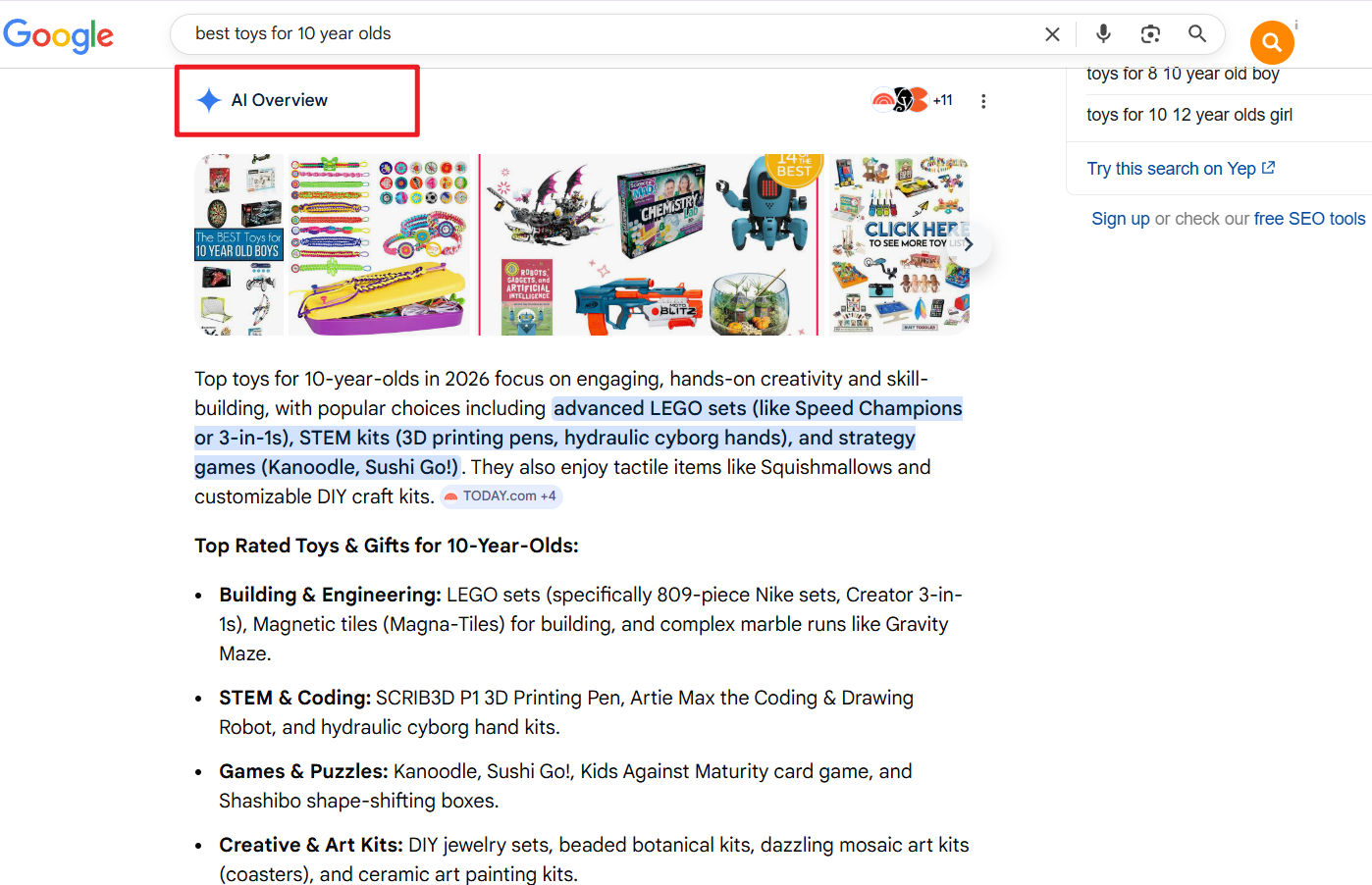
For cross-border businesses that rely on global traffic, GEO has become a core strategy for winning new traffic and standing out from competitors.
Where AI Search Engines Get Product/Brand Recommendations
AI search engines do not generate answers out of thin air. Instead, they analyze massive amounts of public web content, extract information from multiple sources, and combine it into meaningful results. When users ask for product or brand recommendations, AI typically relies on these types of content:
- Blog posts and guides: Content such as product reviews, buying guides, and industry articles. These provide complete, logically organized information and are among the most trusted sources for AI.
- Product pages: Pages that clearly list product specifications, feature descriptions, and use cases are easier to parse for key information.
- FAQs and structured content: Clean question-and-answer layouts reduce AI’s “understanding cost” and increase the likelihood of being cited.
- Forum and community discussions: Real user experiences and feedback on platforms like Reddit and Quora are frequently cited as references.
- Brand mentions and external reviews: positive references to your store from media, third-party blogs, and other websites help build AI’s trust in your brand.
Therefore, if your brand appears consistently across these channels while maintaining a clear structure and complete information, it is much more likely to be cited by AI search engines and featured in AI-generated recommendations.
Key GEO Strategies for Profitable Dropshipping
AI search is gradually changing how consumers search for products. For standalone e-commerce stores, implementing GEO has become essential.
To increase your store’s presence in AI-generated answers and product recommendations, it’s no longer enough to rely on traditional optimization methods. At its core, GEO makes your content easier for AI to read, extract, and cite, boosting your visibility in AI search.
The key strategies below will help you improve your store’s AI search visibility.
- Build Topic Authority Around Your Product Niches
- Optimize Product Pages for AI Understanding
- Use Structured Data for Better AI Interpretation
- Optimise Content for Conversational Search
- Strengthen Internal Links for Better AI Context
- Improve Crawlability and Indexing for AI Search
- Build Strong Brand Authority Signals
Example Workflow: A Simple GEO Strategy for Shopify Stores
As AI search becomes an increasingly important new traffic channel, whether your store appears in AI-generated answers directly impacts the exposure and conversion rate of your e-commerce site.
Data shows that the top three recommended results on AI answer pages capture more than 81.6% of clicks. Websites that are not mentioned in AI recommendations experience an average traffic drop of 67.3%. According to official Shopify data, orders driven by AI-powered search have increased by 15 times since 2025.
The good news is that implementing GEO is not difficult. Using a Shopify outdoor gear store as an example, a basic GEO optimization workflow can be broken down into the following six steps.
Step 1—Extract Product Specs Using AI Tools
First, use AI tools to extract key product information from your store.
For example, you can open Claude and enter this prompt:
“Extract the core specifications of all trail running backpacks from this Shopify store (insert store URL), including weight, capacity, carrying system, and intended use cases. Output the data in a table format.”
This allows you to quickly organize product information into structured data, which is a critical foundation for GEO optimization.
Step 2—Generate Potential User Questions
Next, copy the generated table into Gemini or another AI tool, and use this prompt:
“Based on these product specifications, generate 10 long-tail questions that users might ask an AI assistant. An example: ‘What lightweight backpack should I choose for a two-day, one-night hike at 3,000 meters elevation?’ Include a brief answer for each question, and naturally integrate the brand name and product model into each response.”
These questions and answers will help your content align with real AI search scenarios.
Step 3—Add FAQs to Product Pages
Organize the generated Q&A content into an FAQ section and place it at the bottom of your product detail pages. A clear question-and-answer structure improves user experience and helps AI systems understand your page content more quickly.
Step 4—Publish Your Blog
At the same time, you can further organize these questions and answers into a complete “buying guide” or “use case guide” and publish it on your store’s blog.
Submit the blog to Google Search Console for indexing.
This type of content is far more likely to be recognized by AI systems as a reliable reference source.
Step 5—Build Brand Mentions in Reddit & Quora
Next, search for relevant topics on community platforms like Reddit and Quora, and find high-engagement posts. Use Claude to rewrite the previously generated Q&A content into natural comments, and join discussions with specific use cases and product models.
Note that you do not need to insert links intentionally. Simply let the brand name appear naturally, so AI crawlers recognize it as a trustworthy information source.
Step 6—Track AI Visibility
Finally, use Semrush’s Position Tracking feature to create a new monitoring project and track your brand’s AI visibility.
You can input around 20 core product keywords and use-case keywords, then review how often your brand is mentioned on AI platforms such as ChatGPT, Gemini, and Perplexity each week.
Additionally, you can use Google’s Rich Results Test to check if your store’s product schema markup is complete. Structured data helps AI interpret product information more accurately and serves as an important technical foundation for improving GEO performance.
Final Words: GEO is Not Replacing SEO
With the rapid growth of AI search, many of you in cross-border e-commerce are asking the same question: Will GEO replace SEO?
The answer is no. GEO and SEO are not substitutes—they are complementary, with SEO as the foundational infrastructure and GEO as the advanced layer built on top.
SEO remains the foundation of website visibility. Search engines still rely on signals, including crawlability, page structure, content relevance, and backlinks, to understand and index web pages. Without a solid SEO foundation, your content may not even be discovered by search engines.
GEO serves as a natural extension of this foundation. Unlike traditional SEO, which focuses mainly on search rankings, GEO is built for the new generative AI search environment, with a focus on how AI understands, summarizes, and cites your content.
SEO continues to target traditional metrics such as keyword rankings, click-through rate, branded search volume, and organic traffic quality. On the other hand, GEO introduces new measurement dimensions, including AI mention rate, first-mention rate, question coverage, and citation accuracy.
At their core, GEO and SEO work in synergy, not in competition. SEO builds a stable search foundation for your website, while GEO expands your brand’s exposure in AI-generated answers. Together, they complement each other and strengthen your store’s overall search authority.
For cross-border e-commerce businesses and dropshippers, the truly effective strategy is not to choose between SEO and GEO, but to combine them. With a strong SEO foundation and clear, structured content that AI can easily interpret, you can gain visibility in both traditional search results and AI-generated answers.
As AI search becomes a major discovery channel, the winners of the future will not just be websites with high rankings, but stores and products that AI actively recommends.
SEO gets you ranked. GEO gets you referenced.
Frequently Asked Questions
1. What is the difference between GEO and SEO?
SEO optimizes for traditional search rankings, focusing on keywords, backlinks, and traffic. GEO optimizes for AI platforms, aiming to make your content understood, cited, and recommended by AI.
2. Is GEO replacing SEO?
No. GEO does not replace SEO. SEO remains the foundation that ensures your website can be crawled, indexed, and ranked by search engines. GEO builds on SEO by optimizing content so that AI platforms can reference and recommend it in their generated responses.
3. How can I optimize my Shopify store for AI search?
Optimize product pages, use structured data, add AI-friendly FAQs, publish guide blogs, build brand mentions, and improve site crawlability for AI.
4. Why is my Shopify store not appearing in AI search results?
Your store may not appear in AI search results if the content lacks clear structure, detailed product information, or trustworthy authority signals, AI-targeted FAQs, or sufficient brand mentions across authoritative platforms.


Share Article: